Fountaingrove Hillside Resiliency, Climate Zone 2 Thermal Window Treatments
Fountaingrove's southwest-facing hillside homes face the most demanding thermal conditions in Sonoma County. La Grange Window Coverings specifies Duette Architella R-7.0 insulation and sub-0.12 SHGC solar shading for Fountaingrove rebuilds and new construction, achieving Title 24 2026 compliance while reducing cooling costs by 22 to 40 percent. We coordinate with Fountaingrove architects including Brenda Christopherson and local interior designers to deliver thermal management systems that match the bluff-side luxury these homes demand.
The Fountaingrove slopes of Santa Rosa (ZIP 95404) present a unique convergence of thermal, regulatory, and resilience challenges. Homes rebuilt after the 2017 Tubbs Fire feature high-performance glass that improved upon pre-fire construction, but the 2026 Title 24 update now requires even these newer windows to demonstrate U-factor compliance through added thermal barriers. The hillside elevation and southwest orientation amplify solar heat gain beyond valley-floor norms, making energy-efficient cellular honeycomb shades and solar roller shades essential components of the building envelope rather than decorative afterthoughts.
Why Fountaingrove Hillsides Demand Specification-Grade Thermal Management
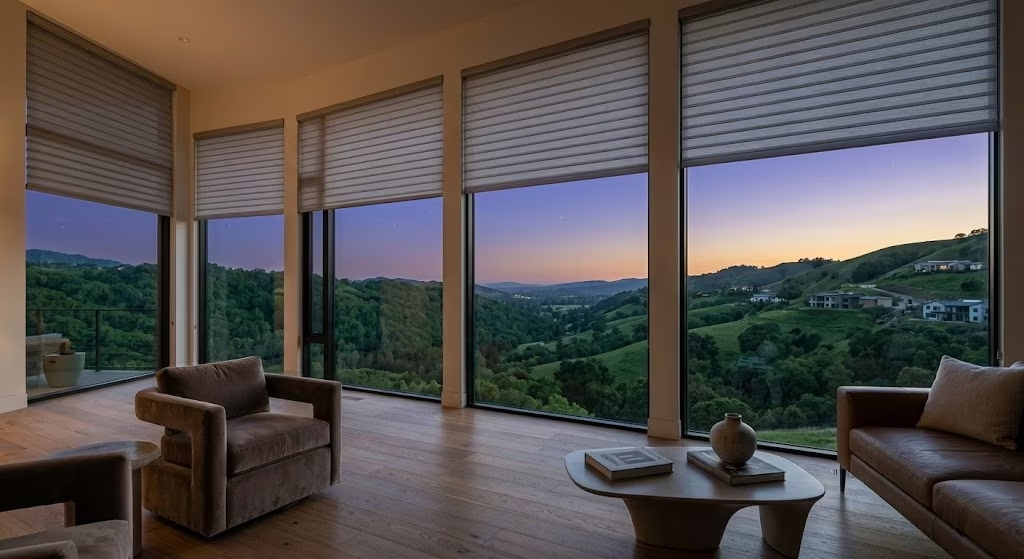
Fountaingrove homes occupy southwest-facing slopes at elevations between 400 and 800 feet above sea level. This orientation creates a near-perpendicular angle to afternoon sun exposure during the summer months, resulting in solar heat gain 30 to 40 percent higher than equivalent valley-floor construction. West-facing glass surfaces can exceed 140°F during peak hours, driving interior air temperatures that overwhelm even high-capacity HVAC systems. The thermal stress is compounded by the panoramic window design that defines Fountaingrove architecture, expansive glass that captures views of Bennett Valley, Taylor Mountain, and the Laguna de Santa Rosa requires proportionally larger window treatment coverage.
The 2026 Title 24 energy code recognizes this challenge. Climate Zone 2, which covers the inland Santa Rosa corridor including Fountaingrove, imposes the strictest U-factor and SHGC thresholds for residential fenestration. Standard dual-pane Low-E glass at U-factor 0.30 no longer qualifies. NFRC-rated Title 24 compliant window treatments bridge the gap, transforming windows that fail the code into assemblies that exceed it.
Dual-Layer Thermal & Solar Control System
La Grange specifies a dual-layer approach for Fountaingrove hillside homes: a primary Duette Architella triple-cell shade for thermal insulation (R-7.0, combined U-factor 0.23) paired with a secondary 1% openness solar roller shade for SHGC control (0.12). The thermal layer addresses heat loss during winter and heat gain during summer through trapped air pockets that create an insulating barrier. The solar layer rejects radiant heat before it passes through the glass, reducing the cooling load by 22 to 40 percent depending on orientation and glass area.
Both layers operate independently on whisper-quiet motorized Somfy drives, enabling automated scheduling that responds to time of day, sun angle, and season. Morning scenes open the solar layer to admit natural light while keeping the thermal layer retracted. Afternoon scenes deploy the solar layer on west-facing glass to reject peak heat gain. Evening scenes lower the thermal layer across all exposures to reduce heat loss. This automated approach eliminates the homeowner burden of manual shade management while optimizing energy performance throughout the day.
Fountaingrove Hillside Performance Specifications
| Feature | Value | Notes |
|---|---|---|
| R-Value (Architella Triple) | R-7.0 | Highest available — blocks 50% of solar heat gain |
| Combined U-Factor | 0.23 | Exceeds Title 24 2026 threshold of 0.27 |
| SHGC (West-Facing) | 0.12 | 1% openness solar — meets strictest CZ2 requirement |
| Cooling Savings | 22–40% | Verified in Fountaingrove hillside installations |
| Heating Savings | 18–25% | Winter heat loss reduction through insulating air pockets |
| Motor Noise | Sub-35 dBA | Whisper-quiet Somfy for hillside open-plan layouts |
| Wind Rating | Motorized retraction | Automated retraction on wind speed triggers |
| Fire-Rated Glass Compatibility | All shade types | Compatible with WUI-compliant glazing |
Fountaingrove Window Treatment Questions
Why do Fountaingrove hillside homes have extreme thermal management challenges?
Fountaingrove homes sit on southwest-facing slopes at elevations between 400 and 800 feet, receiving direct afternoon sun exposure for 8 to 10 hours during summer months. The hillside orientation amplifies solar heat gain compared to valley-floor homes because the glass plane faces the sun at a more perpendicular angle during peak hours. Combined with Climate Zone 2 summer temperatures exceeding 100°F in the inland Santa Rosa corridor, west-facing and south-facing glass walls experience surface temperatures that can exceed 140°F. This thermal load overwhelms standard HVAC systems and degrades interior furnishings within a single season without proper window treatment intervention.
How do window treatments help Fountaingrove homes meet Title 24 2026 energy code?
The 2026 Title 24 update requires window assemblies in Climate Zone 2 to achieve a U-factor of 0.27 or lower. Fountaingrove homes rebuilt after 2017 with high-performance dual-pane Low-E glass typically carry U-factors around 0.30, which no longer meets the new threshold. Adding Duette Architella triple-cell shades brings the combined assembly U-factor to 0.23, exceeding the requirement with margin. For west-facing glass, 1% openness solar shades achieve SHGC values of 0.12, well below the 0.17 target. La Grange provides complete NFRC documentation for all Title 24 permit submissions on Fountaingrove projects.
Can motorized shades integrate with wildfire early warning and automated home defense systems?
Yes. Somfy and Savant platforms support integration with home automation systems that monitor weather conditions including wind speed, temperature, and air quality index. Motorized shades can be programmed to retract automatically during high-wind events to reduce mechanical stress on shade fabrics and mounting hardware. When paired with smart home platforms that monitor fire weather conditions, shade scenes can be triggered to protect interior furnishings and reduce radiant heat exposure through glass during smoke events. La Grange coordinates with home automation integrators on Fountaingrove projects to ensure shade systems participate in the home’s overall resilience strategy.
What window treatments does La Grange recommend for Fountaingrove rebuild projects?
For Fountaingrove rebuilds, we specify a layered approach: Duette Architella triple-cell shades for maximum thermal insulation on all exposures, combined with 1% openness solar roller shades on west-facing and south-facing glass for SHGC control. This dual-layer system addresses both U-factor and SHGC requirements simultaneously while delivering the thermal comfort and energy savings that hillside homeowners expect. All systems are motorized with whisper-quiet Somfy drives for automated scheduling and smart home integration. We coordinate with the general contractor during framing for recessed mounting where the architectural design calls for concealed hardware.
Explore More Solutions
Title 24 Compliance 2026
Meet California energy code with NFRC-rated window treatments.
Energy Efficiency
15–25% HVAC cost reduction with honeycomb insulation.
Santa Rosa Service Area
Window treatment services for Fountaingrove and Santa Rosa neighborhoods.
Cellular & Honeycomb Shades
Duette Architella R-7.0 for maximum thermal insulation.
Smart Home Automation
Automated sun-tracking schedules for hillside thermal management.
Architectural Glass
Floor-to-ceiling solutions for panoramic hillside glass walls.
Solve Your Fountaingrove Thermal Challenge
Veronica Thompson brings specification-grade thermal analysis to every Fountaingrove consultation, mapping each window orientation, calculating combined U-factor and SHGC values, and specifying the products that deliver Title 24 compliance with maximum energy savings.